
Welcome to the Metro Relay Library.
A collection of guides, playbooks, field notes, and insights from the Metro Relay team.
Who Owns the Infrastructure Behind Virtual Patient Observation?
It is three in the morning and a monitoring station has just lost the feed from one of the rooms it was watching. The observer calls IT, who look at the network, see nothing obviously wrong, and suggest the cart is the problem. Clinical engineering checks the cart, finds it powered on, and points back at the network.
Caregility iObserver Is a Video-First Clinical Application. Is Your Network Ready?
Early evening on a busy unit, a virtual observer is watching a dozen rooms on Caregility iObserver. Admissions are stacking up, staff phones and tablets are all live on the wireless network, and visitors are streaming video in the waiting area. On the observer's screen, several tiles begin to stutter, then freeze;
NESA and the Smart Patient Room Need More Than an AI Camera
A hospital installs its first "smart" patient rooms. The devices on the wall run NESA's platform — edge-based artificial intelligence that uses computer vision to watch for falls and clinical changes, listens ambiently to help document care, and writes back into Epic natively.
Your Hospital Bought AvaSure. Who Is Maintaining Everything Around It?
It is the middle of a night shift, and a virtual safety attendant is watching a grid of patient rooms on the AvaSure platform. In one tile, a patient at high fall risk starts to shift toward the edge of the bed
Virtual Patient Observation Has a Privacy Problem If the Infrastructure Is an Afterthought.
A hospital rolls out virtual observation the efficient way. Carts and cameras arrive, the vendor confirms the product is HIPAA compliant and the video is encrypted, and the program goes live. What no one examined is that the cameras were dropped onto the same flat network as the guest Wi-Fi
When the Telesitter Goes Offline, Who Is Watching the Patient?
At 2:40 in the morning, the wall of video feeds in the monitoring room turns gray. A network switch is being upgraded, or a wireless controller has decided to reboot itself, or a circuit has dropped — the cause barely matters yet
Hospitals Are Building Virtual Nursing Command Centers. The Room Is the Easy Part.
It is two in the morning, and a nurse who has not set foot on a patient floor all shift is admitting a new arrival three buildings away. Over a high-definition video link, she walks the patient through medications and consent while the bedside team keeps moving.
A Telesitter Is Not a Camera. It Is Clinical Infrastructure.
Picture a medical-surgical floor at three in the morning. In a room down the corridor, a technician scans a grid of muted video tiles. On one, a patient who was resting a moment ago now has both legs over the side rail, reaching for an IV pole.
DFW Businesses Don't Need More Technology. They Need Better Maintenance.
The industry has trained companies to keep buying. The next infrastructure cycle is about maintaining, documenting, and taking ownership of what they already have.
The Next DFW Outage May Begin Inside Your Own Building
Businesses plan for regional outages they cannot control while overlooking the more likely failure, the one that starts with a single component inside their own walls.
Deferred IT Maintenance Is More Expensive Than Planned Replacement
Putting off maintenance feels like saving money because the cost of delay is invisible. It is usually the larger bill, arriving later and at a worse moment.
DFW Keeps Growing. Can the Systems Underneath It Keep Up?
North Texas added more than 200,000 residents in a single year. That same pressure is landing inside individual businesses, on infrastructure that was never sized for it.
Your IT Infrastructure Is Older Than It Looks
A computer that turns on tells you almost nothing about the health of the systems around it. Real age is measured by support, recoverability, and security.
The Network Closet Nobody Has Touched in Ten Years
In many DFW businesses, the network everything depends on sits in an unlabeled closet no one owns, no one documents, and no one inspects until something fails.
North Texas Reached Nearly 9 Million People. Now It Has to Maintain All of It.
The roads, utilities, and power grid are not the only systems under strain. Inside DFW businesses, aging networks and years of deferred technology maintenance are reaching the same point.

Moving Your Business to Plano or Frisco? Bring in Technology Before the Floor Plan Is Finished
A new headquarters can have finished walls, beautiful furniture, and a signed certificate of occupancy — and still be weeks away from being operational.
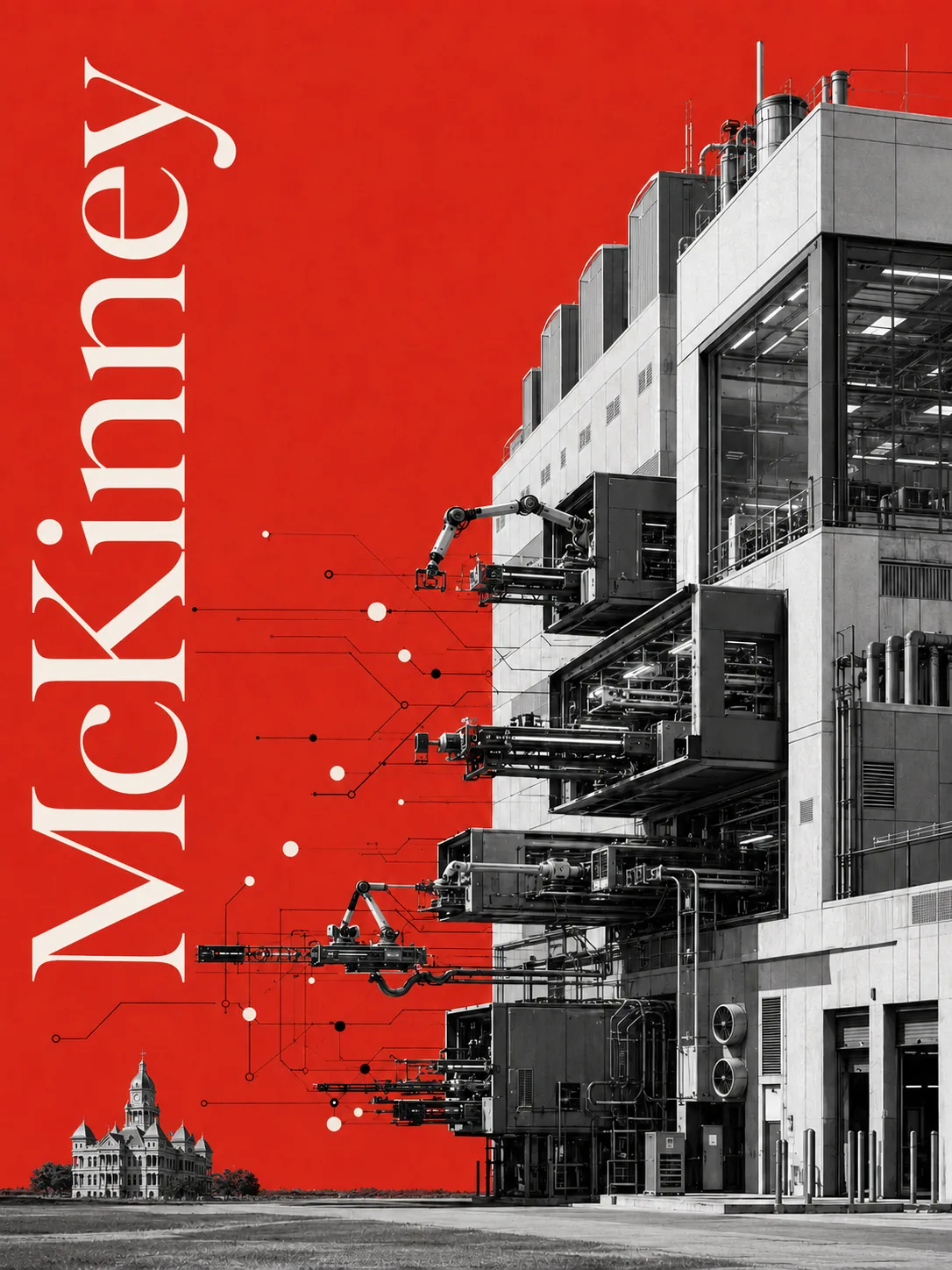
McKinney Just Won a $919 Million AI Manufacturing Campus. The Hard Part Begins When the Machines Connect
Announcements of this size are read as construction stories. The more useful reading is that a large, complex production environment is about to be assembled inside a building that was designed for something else, by dozens of vendors working simultaneously, over a multi-year phased schedule.

Texas AI Law Is Already Here. Most North Texas Companies Still Cannot Name the AI Systems They Use
Six months into the Texas AI law, the useful executive question is not "are we compliant?" It is narrower and considerably more uncomfortable: can you produce a list?

North Texas Wants the AI Economy. Fort Worth Is Asking What the Infrastructure Will Cost
The constraint on AI growth in North Texas is shifting from silicon to substations. Fort Worth's proposed data center standards are not a referendum on whether AI infrastructure should exist — they are a working example of the specific physical and civic questions that determine where it can be built and how fast. The next phase of AI growth will be constrained as much by power, water, land use and public trust as by computing hardware.

When a North Texas Business Changes Hands, the Buyer Inherits Every Forgotten Password
A buyer can own a company outright and still be unable to operate it. The purchase agreement transfers legal title to assets. It does not transfer administrative control of the systems those assets run on — and control is what determines whether the business functions on the Monday after closing.

The $100,000 AI Agent Mistake North Texas Businesses Are About to Make
The demonstration is impressive, and it is supposed to be. The agent follows up with prospects, updates the CRM, reads the contract, opens the ticket, and never sleeps. The proposal says $30,000. What the business is actually buying is authority — the right for software to act inside its systems, its inbox, and its customer relationships. Here are the twenty questions to ask before that authority is granted.

Paying for AI Tokens Is Not the Same as Getting Business Value.
The bill measures how much you consumed. It never measures whether it helped.
AI Is Becoming Infrastructure. Treat It That Way.
A space heater is an appliance. Central heating is infrastructure. The difference is who depends on it when it fails.
Who Owns Your AI Data? The Question Every Executive Should Ask.
You can hold the title to your data and still not control it. Ownership is a bundle of rights, and the terms decide how many you keep.
Shadow AI Is the New Shadow IT.
When the official path doesn't go where people need it, they make their own. The trail they wear is telling you something.
The AI Bubble Will Not Kill AI. It Will Kill Bad AI Deployments.
Corrections don't end technologies. They repossess the parts that were never paying for themselves.
AI Is Not the Strategy. Control Is the Strategy
Adopting AI is easy. Controlling the data, the workflow, the cost, and the outcome is the part that actually decides whether it helps.
The Most Dangerous Technology Budget Is the One That Looks Responsible
On a spreadsheet, discipline and starvation look identical. The difference is in what got cut. Every budget season produces a technology budget that everyone can feel good about. It holds spending flat, it contains no surprises, and it can be defended to the board in a single sentence: we held the line on IT. It looks responsible, and it gets approved with relief. The trouble is that the same flat number can be produced two entirely different ways — by cutting waste, or

North Texas Is Growing Faster Than Enterprise Infrastructure
Dallas–Fort Worth has led the nation in corporate relocations for years, and the growth is not slowing. That pace is an opportunity, and it is also a stress test. Rapid expansion pulls organizations into scaling faster than they planned to — new locations, more people, heavier demand — and the planning capability that should guide that scaling often cannot keep up. The result is a quiet but consequential gap: the region is growing faster than many organizations can mature their infrastructure pl
The Building Passed Inspection. Your Infrastructure Didn't.
When a building passes inspection, the project feels finished. The code official signed off, the structure is sound, the electrical is safe, the fire systems work — and that approval reads, to most people, as confirmation that the building is ready. But a building inspection answers a specific question: does the construction meet code and is it safe to occupy. It does not ask whether the network performs, whether the cabling is certified, whether wireless covers the space, or whether the connect
Technology Debt Is Leadership Debt
When technology debt surfaces — the outdated system, the fragile integration, the modernization that should have happened years ago — the conversation usually turns to IT. But trace the debt back to its origin and you rarely find a technical decision. You find a budget decision, a timing decision, a priority decision, a growth decision, each made above IT and each reasonable in the moment. Technology debt is not, for the most part, something IT created. It is something leadership authored and IT
Technology Infrastructure Is the Last Competitive Advantage Nobody Talks About
Strategy conversations are about visible things — products, pricing, markets, brand, talent. Infrastructure almost never comes up, because it is not what anyone competes on out loud. Yet the foundation a company runs on quietly sets the limit on how fast it can move, how reliably it operates, how securely it handles its data, and how well it grows. When that foundation is strong, every initiative on the strategy deck moves faster and costs less to execute. When it is weak, every one of them is t
The Office Looks Perfect. The Infrastructure May Not Be.
Walk into a newly built corporate office and the first impression is the finishes — the millwork, the lighting, the furniture, the carefully designed common areas. What you cannot see is the infrastructure those impressions depend on: the network, the wireless, the cabling, the power. The visible parts get the budget and the attention because they are the parts people notice and photograph. The invisible parts get evaluated last and noticed only when they fail. A space can be designed impeccably
Before Signing a Lease, Ask These Technology Questions
No one buys a commercial building without an inspection. Yet organizations routinely sign multi-year leases — committing to operate their business in a space for the better part of a decade — without ever inspecting whether the building's technology can support them. The lease gets evaluated on rate, square footage, and location, all of which are on the term sheet. Carrier serviceability, riser capacity, power, and redundancy are not on the term sheet, so they are not evaluated. The questions th
Your Broker Found the Building. Who's Planning the Infrastructure?
A corporate relocation assembles an impressive team. A commercial broker finds the building and negotiates the lease. An architect designs the space. A general contractor builds it. A landlord delivers it. Movers populate it. Every role is filled by a specialist who is excellent at their job — and not one of those jobs includes long-term technology planning. The most consequential question in the move, whether the building can actually support the business, lands in a chair no one is sitting in.
Occupancy Doesn't Equal Readiness
A certificate of occupancy feels like a finish line. The building is done, the inspectors signed off, the keys change hands, and the move gets scheduled. But it is the keys to a house whose water and power have not yet been switched on — legal to enter, not yet ready to live in. But a certificate of occupancy answers a narrow question — is the building safe and legal to enter — and that is not the question the business is asking. The business is asking whether the network works, the phones ring,
The Companies Moving to North Texas Are Rebuilding More Than Their Headquarters
North Texas has led the country in corporate headquarters relocations for seven years running, and the moves keep coming. From the outside, each one looks like a real estate story: a new building, a new address, a moving date. Operationally, it is something else entirely. The desks and monitors get packed and shipped, but the systems the business actually runs on — connectivity, network, identity, security, continuity — do not move. They are rebuilt at the new site, from scratch, on timelines lo
Ambient AI Is Changing Healthcare IT Faster Than Most Organizations Realize
Most healthcare technology arrives slowly, through committees, pilots, and IT projects. Ambient AI is arriving differently. A clinician hears about it from a colleague, turns it on, and starts using it in a single afternoon — no workflow change, no integration project, often no conversation with IT. That ease is exactly what makes it spread faster than leadership realizes, and exactly why the organization's exposure can outrun its readiness before anyone responsible for infrastructure, security,
Structured Cabling Is Only One Piece of Modern Building Technology
Structured cabling gets most of the attention in a building's technology conversation, because it is the part with a clear price per drop. But cabling is the foundation, not the building. Sitting on top of it is an interconnected set of systems — networking, wireless, security, audiovisual, connectivity, and increasingly the building's own controls — that now share the same cabling, the same rooms, and the same network. Treating them as separate purchases is how buildings end up working in piece
Planning Business Fiber Before Construction Begins in Dallas–Fort Worth
A building can be finished, furnished, and inspected, and still be unusable on opening day for one reason: the fiber is not in yet. Of all the technology decisions on a commercial project, connectivity is the one most often assumed to be available on demand, and the one most outside the construction schedule's control. Business fiber behaves like a utility that has to be brought to the site, and treating it like a service you switch on at the end is how opening days slip.
When Should a General Contractor Bring in an IT Infrastructure Consultant?
On most commercial projects, the technology consultant gets a phone call at the worst possible moment: after the walls are framed, the conduit is run, and the closet is already too small. By then the building has made every important technology decision by accident. The question of when to involve a technology infrastructure consultant is really a question of whether technology gets designed or merely discovered, and the answer has direct consequences for a general contractor's schedule and marg
Future-Proofing Commercial Buildings Across Dallas–Fort Worth
"Future-proof" is one of the most overused words in commercial construction, and one of the most misunderstood. It usually gets interpreted as buying the newest technology available, which guarantees only that the building owns equipment that will also age. Real future-proofing is quieter and cheaper: it is the spare conduit, the extra power capacity, and the headroom in the cabling and rooms that let a building absorb whatever comes next without being torn open. The goal is not to predict the f
AI Governance for Clinics: The New Compliance Program Nobody Planned For
Healthcare organizations know how to build a compliance program; they spent two decades building one for HIPAA. AI did not wait for a second one. It is already in the building — in scribes, in chatbots, in features bundled into software clinics already own — and almost none of it passed through a governance gate. This is about building the program that got skipped.
The Hidden HIPAA Risk Inside AI Medical Scribes
Every clinic weighing an AI scribe asks the same question: will it ease the documentation burden that is driving clinicians out? Almost none ask the question that matters more later — what happens to the recording after the visit ends. The first question is about wellbeing. The second is the one that surfaces in an audit, a breach response, or a subpoena, and it is the one this piece is about.
What Cyber-Insurance Auditors Are Actually Looking For in 2026
Executive Introduction A cyber-insurance renewal used to be a form. You attested to your controls, the carrier took your word, and a quote arrived. That arrangement ended when the ransomware losses came due and carriers learned how many policyholders had overstated their defenses. The renewal is now an audit, and what it surfaces is often news to the leadership being audited.
What Clinic Owners Need to Know Before Implementing Ambient AI
Ambient AI is adopted as a productivity tool but functions as a system that records and processes the most sensitive moments in medicine, which makes governance, not accuracy, the decisive issue.
The Hidden Cost of No-Shows: How Texas Clinics Are Using Automation to Recover Revenue
A no-show is treated as an empty time slot, but its full cost compounds across lost revenue, idle staff and rooms, a patient whose care is now delayed, and a schedule distorted by defensive overbooking.
What Happens When Your EHR Goes Down? Lessons From Healthcare Business Continuity Planning
EHR downtime is widely treated as an IT problem solved by backups and uptime guarantees, when it is an operational-continuity problem that requires rehearsed clinical and administrative protocols.
Why DFW Clinics Are Investing in AI Medical Scribes Instead of Hiring More Staff
The choice between an AI scribe and additional staff is usually framed as cost control, when the real driver is a labor market that cannot supply clinicians and a documentation burden pushing the clinicians a practice already has toward the exit.

The Technology Behind the 15-Minute City
The 15-minute city is discussed as an urban-planning idea, yet its viability rests on a connectivity layer that most master plans scope as an amenity rather than a foundation.

Technology Infrastructure Planning for Modern Mixed-Use Developments
In mixed-use assets, the capacity to re-tenant, expand, and adapt is largely fixed by base-building infrastructure choices made years before the first lease is signed.
25 Technology Decisions That Are Expensive to Fix Later
The most expensive technology mistakes in commercial construction are committed during design and rough-in, then sealed behind walls and slab where correction costs multiples of the original decision.

What Business Owners Should Ask Before Hiring an IT Support Provider
Most advice on hiring an IT provider hands you a list of questions to fire at vendors, treating selection as a quiz the provider passes or fails. That misses half the value. The questions you think to ask are as revealing as the answers you receive — they expose what you already understand about your own environment and, just as often, what you have never thought to check.

Dallas IT Support vs Managed IT Services: Which Is Right for Your Business?
"Dallas IT support vs managed IT services" frames the decision as a choice between two competing products. It is more accurately a choice between two relationships to operational risk: one fixes technology after it fails, the other runs technology so it fails far less often.

Ethical AI and Operational Resilience: The Next Leadership Challenge
Most conversations about AI ethics happen at the wrong altitude. They tend to orbit the dramatic — autonomous weapons, existential risk, the philosophical status of machine intelligence — while the decisions that actually matter are being made quietly, at the desk level, by people who don't know they're making ethical choices at all.
How Much Does IT Support Cost in Dallas-Fort Worth in 2026?
In 2026, most Dallas-Fort Worth businesses pay roughly $100 to $175 per user per month for fully managed IT support, while hourly break-fix help runs $125 to $250 per hour. Yet identical offices routinely receive quotes that differ by hundreds of dollars per seat, because the headline number says almost nothing about what is included. This guide breaks down the real DFW market ranges